


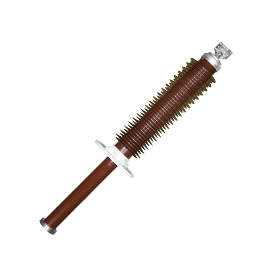
Circuit Breaker Voltage Bushing
Circuit breaker bushings are one of the core components of high-voltage electrical equipment, with various types mainly classified according to the type of circuit breaker, voltage level, and insulation structure...
Product Profile
Overview and Classification
Circuit breaker bushings are one of the core components of high-voltage electrical equipment, with various types mainly classified according to the type of circuit breaker, voltage level, and insulation structure.
By circuit breaker type: mainly divided into SF6 circuit breaker bushings, vacuum circuit breaker bushings, oil circuit breaker bushings, etc.
By insulation structure: This is the classification of cores, mainly divided into the following three types:
Single insulated bushing: relatively simple structure, using pure porcelain or resin as insulation, commonly used for voltage levels of 35kV and below.
Composite insulated bushing: the interior is oil-filled or gas-filled as the main insulation, while the exterior is a ceramic bushing. Internally, it is often filled with transformer oil or SF6 gas, used for voltage levels of 35kV and above.
Capacitive bushing: The most complex structure, with a "capacitive core" made of multiple layers of insulation and metal foil to distribute the electric field internally. It is mainly used in circuit breakers with ultra-high voltage (110kV and above).
Main applications
The application scenarios of circuit breaker bushings are closely related to the circuit breaker itself:
SF6 circuit breakers and GIS: One of the most widely used scenarios, serving as incoming and outgoing line bushings to connect to the external power grid.
Tank circuit breaker: used at the outgoing end of tank SF6 circuit breakers or GIS (gas-insulated metal-enclosed switchgear).
Porcelain column circuit breaker: used in the insulating posts, extinguishing chamber, and closing resistor of porcelain column SF6 circuit breakers.
Vacuum circuit breaker: Used as insulation and support for incoming and outgoing lines of pole-mounted or box-type vacuum circuit breakers.
Other high-voltage electrical devices: also used for connections with equipment such as transformers and lightning arresters.
Product features
High electrical insulation and mechanical strength: To meet the mechanical strength and thermal stability requirements of high-voltage electrical appliances, high-strength porcelain formulas with higher alumina content are often used. The finished product must undergo rigorous four-way bending tests to ensure its flexural strength and long-term operational reliability.
Excellent sealing and weather resistance: To ensure sealing, both ends of the ceramic sleeve undergo high-precision grinding. The flange is coated with waterproof silicone rubber to prevent additional stress caused by freezing moisture in cold regions.
Excellent anti-fouling and flash resistance: Often uses an umbrella-shaped design with alternating sizes and sizes. The large umbrella protects the smaller umbrella below from contamination, thereby improving the discharge characteristics between umbrellas and enhancing stain resistance.
High customizability: porcelain pieces can be fired into various glaze colors such as brown, white, or gray. Flange materials can be cast aluminum alloy or ductile iron, with surface treatments such as anodizing and hot-dip galvanizing.
Strict factory inspection: In addition to routine dimensional checks, ultrasonic flaw detection, internal pressure testing, and electrical testing are also conducted.
Technical parameters and standards
Main technical parameters: rated voltage from 40.5kV to 550kV, creepage ratio distance of 25 to 31mm/kV, internal voltage failure load 0.5 to 6.0MPa.
Main standards followed:
GB/T 4109: "Insulating bushings with AC voltage above 1000V" is a core product standard.
GB 50150: "Electrical Installation Engineering - Electrical Equipment Handover Test Standard," specifies on-site testing of sleeves.
GB/T 5273: "Wiring Terminals for Transformers, High-Voltage Electrical Apparatus and Bushings".
IEC 60137: International Electrotechnical Commission standard.
Selection and precautions
Key points for model selection
Clarify system parameters: Confirm key parameters such as rated voltage, rated current, and short-circuit capacity of the circuit breaker.
Determine the installation environment: Choose the appropriate stain-resistant or standard product based on whether it will be used outdoors or indoors.
Considering altitude: Standard products are suitable for areas with elevations of 1000 meters and below. High-altitude areas require the use of plateau plates or consult with manufacturers.
Matching circuit breaker type: Ensure the selected bushing matches the type of circuit breaker (such as SF6, vacuum) and structure (such as tank type, porcelain column type).
Installation and maintenance
Handling and installation: During handling, it is strictly forbidden to apply stress to the ceramic casing to prevent breakage. During installation, climbing sleeves or mounting ladders on insulators is strictly prohibited.
Environmental requirements: SF6 circuit breakers should be installed in conditions free of wind, sand, rain, or snow, and the relative humidity of the air should not exceed 80%.
Sealing inspection: Before installation, check whether the glue joints of the ceramic sleeve and flange are tight and secure.
Handover test: After installation, insulation resistance, dielectric loss factor (tanδ), and AC withstand voltage tests should be conducted according to standards such as GB 50150.
Operation and Maintenance: Regularly check the surface of the ceramic sleeve to ensure it is clean, free of discharge traces, and free of cracks. If the tanδ of the main insulation of the bushing is found to be excessive or the seal is damaged, it should be dealt with promptly.
Application environment
Temperature: The standard applicable ambient temperature is -40°C to +40°C.
Altitude: Standard applicable altitude not exceeding 1000 meters; Some products can be used in areas at altitudes of 4000 meters.
Pollution: Can be designed with high pollution levels such as Class III and Class IV.