


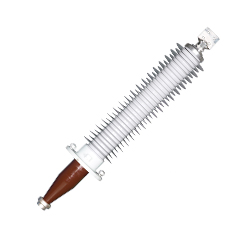
GIS Voltage Bushing
GIS bushings are high-voltage insulating bushings, whose core function is to safely guide current-carrying conductors into or out of GIS equipment busbars, while providing critical insulation and sealing for the equipment casing...
Product Profile
GIS bushings are high-voltage insulating bushings, whose core function is to safely guide current-carrying conductors into or out of GIS equipment busbars, while providing critical insulation and sealing for the equipment casing. They are typical "cross-boundary" products, usually with one end operating in the open air (connecting to overhead lines or cables) and the other end operating in the SF6 gas environment inside GIS equipment.
Product Applications
GIS bushings are used in very focused scenarios and are key interfaces connecting different power equipment:
1.GIS outgoing bushings: Used in GIS substations to connect GIS equipment with overhead lines or cables.
2.Transformer connections: As "oil-SF6 bushings," used to directly connect oil-filled transformers with SF6 metal-enclosed switchgear (GIS).
3.Wall penetration: Used for high-voltage lines passing through walls or floors.
4.Other equipment: Also used to connect with high-voltage equipment such as surge arresters, circuit breakers, and capacitors.
Product Features
Modern GIS bushings are designed for high reliability, safety, and maintenance-free operation, with the main features as follows:
Excellent insulation structure: Often uses a capacitive grading structure; the main insulation is solid insulation made of glass fiber wound with epoxy resin. This "dry" design fundamentally avoids oil or gas leaks.
High safety:
1.No oil, no gas, no explosion: The bushing itself contains no oil, and the outdoor part has no SF6 gas, so there’s no risk of leaks or explosions.
2.High mechanical strength: Excellent mechanical performance allows it to meet seismic-resistant requirements.
3.Reliable, maintenance-free operation: Solid insulation means no inspection or maintenance is required during operation.
Strong environmental adaptability
1.Low-temperature resistance: Especially suitable for low-temperature environments, avoiding insulation failure due to gas liquefaction.
2.Flexible installation angles: Can be installed horizontally, vertically, or at any angle.
3.Optimized current-carrying method: Some products use a finger-type current path instead of traditional threaded connections, effectively avoiding heating and keeping contact resistance stable over time.
4.Online monitoring available: By detecting tap connections, the system can monitor key parameters such as capacitance and dielectric loss factor in real time.
Typical Technical Specifications
For common market products, the parameter ranges are:
Rated voltage: 126kV–550kV
Rated current: 630A–6000A
Main insulation: Glass fiber impregnated with epoxy resin (dry type)
External insulation: Silicone rubber or porcelain
Applicable standards: GB/T 4109, IEC 60137, etc.
Product Classification
From market and product type perspectives, GIS bushings can be mainly divided into:
By insulation structure: Capacitive and non-capacitive.
By external insulation material: Porcelain bushings and silicone rubber composite bushings.
Product Precautions
Altitude and temperature: Standard products are suitable for altitudes up to 1000 meters, with ambient temperatures usually between -45℃ and +40℃. For conditions beyond these ranges, consult the manufacturer.
Sealing: Pay special attention to sealing at connections with GIS equipment or transformers to ensure SF6 or transformer oil does not leak.
Connection structure: For transformer connections, clarify whether it is a direct oil-SF6 bushing connection, or involves other intermediate structures.