


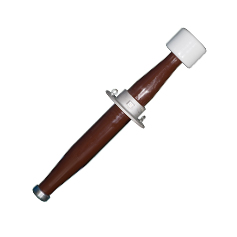
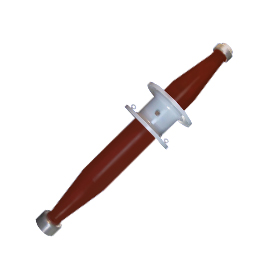
SF6 Circuit Breaker Voltage Bushing
The oil-SF6 bushing is a key component that connects oil-immersed transformers and SF6 gas-insulated metal-enclosed switchgear (GIS). One end is immersed in the transformer’s insulating oil...
Product Profile
The oil-SF6 bushing is a key component that connects oil-immersed transformers and SF6 gas-insulated metal-enclosed switchgear (GIS). One end is immersed in the transformer’s insulating oil, while the other operates in the SF6 gas environment of GIS equipment, acting as a "bridge" between the two different insulating media.
Core Application: Connecting two key power devices
Main Use: Provides a direct transition connection between oil-immersed power transformers and SF6 fully-enclosed switchgear (GIS) or SF6 bus ducts.
Installation Method: Supports horizontal, vertical, or any angled installation, flexibly adapting to various substation layouts.
Custom Design: Its flanges and terminals can be specially designed according to the specific interface requirements of the transformer and GIS equipment.
Core Features: Safe, reliable, maintenance-free
Dry and oil-free, explosion-proof: Mainly uses RIP (resin-impregnated paper) technology, with solid main insulation containing no oil, completely eliminating the risk of oil leakage and explosions.
Environmentally friendly and maintenance-free: Solid insulation materials are eco-friendly and pollution-free, and the product requires no maintenance throughout its lifecycle.
Excellent performance and high mechanical strength: Main insulation has stable electrical properties, with minimal partial discharge and dielectric loss. The overall mechanical strength is high, with good seismic resistance.
Reliable contact and low temperature rise: Often uses a finger contact current-carrying structure instead of traditional threaded connections, effectively avoiding contact heating.
Excellent sealing and strong adaptability: Multi-layer sealing design provides outstanding sealing and corrosion resistance, suitable for various harsh environments.
Key Technical Parameters and Classification
Voltage and Current: Rated voltage ranges from 12kV to 550kV, and rated current ranges from 630A to 6000A.
Main Insulation Technology: Mainly divided into RIP (resin-impregnated paper) and OIP (oil-impregnated paper). RIP is more widely used due to its excellent performance.
Standards Compliance: Product design and testing mainly follow common standards like GB/T 4109, IEC 60137, and DL/T 1408 for ultra-high voltage applications.
Selection and Considerations
Clarify system parameters: First confirm key parameters such as the rated voltage and rated current of the transformer and GIS system.
Confirm interfaces and dimensions: Check the flange dimensions and connection methods at both ends of the bushing with the equipment manufacturer to ensure physical compatibility.
Consider environmental conditions: Standard ambient temperatures are usually -45℃ to 60℃, but you should confirm based on the actual installation location’s temperature, altitude, and other conditions.
Check sealing performance: Inspect all sealing parts thoroughly before and after installation to prevent gas or liquid leakage.
Conduct handover testing: After installation, perform insulation resistance, dielectric loss factor (tanδ), and partial discharge tests according to standards.
Pressure monitoring (for OIP type): If choosing an OIP bushing, check if it is equipped with a gas pressure monitoring device to provide an alarm in case of SF6 gas leakage.